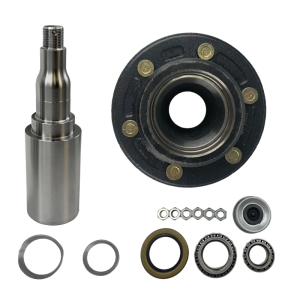
Trailer spindle and hub

Reliability where it matters the most.

Trailer Stub Axle: Installation & Use Guide

Finding a well-fitting trailer stub axle—for replacement or custom builds—can be a hassle. Off-the-shelf parts rarely meet specific brake or length needs. Our spindle-hub stub axles solve this: built tough for heavy use, and flexible for your setup.

Replacement & Custom Builds

Our stubs work for both replacements and new builds. For replacements: Remove the old axle and slide ours in—no mount reworking. For new builds: Weld your axle tube, bolt on our assembly—no fancy tools needed.

One size doesn’t fit all. We offer three setups based on your trailer’s use:

  • Idler Drum Stubs: For unpowered axles (utility, cargo, boat trailers). Cast iron drums resist warping in heat/rain.
  • Electric Brake Assemblies: For reliable stopping (RVs, horse, medium freight trailers). Syncs with tow vehicle controllers.
  • Mechanical Disc Brakes: For heavy loads/rough terrain (construction, equipment trailers). Handles heat better than drums.

Customization Options

Have a blueprint? Send us 2D/3D drawings—we’ll match every dimension (spindle diameter, hub offset, etc.). If you can draw it, we can build it.

Installation & Usage

Installing our stubs is straightforward. We’ve guided hundreds of U.S. shops through it. Below are key steps and maintenance tips.

Two Key Installation Scenarios

  1. Replacing a Worn Stub Axle

Tools needed: Jack stands (never rely solely on a jack), torque wrench, socket set, wire brush, matching bearing grease. Safety first: Jack up the trailer, secure with stands, then remove the wheel.

  • Remove the wheel, then the brake assembly. For electric brakes, disconnect and tuck the wiring harness to avoid damage.
  • Remove the old hub/spindle. Scrub the axle tube’s mounting surface—rust/debris ruins alignment.
  • Slide in the new stub axle. For bolt-on types, tighten bolts in a crisscross pattern to 120-150 ft-lbs (follow axle specs).
  • Repack the hub with grease, reinstall brakes and wheel. Torque wheel lugs to spec—avoid over/under-tightening.
  1. New Build: Welding to Axle Tube

Welding our stub to your tube is simple—precision matters. Keep the tube straight; grind off paint/rust from the weld area (clean metal bonds better).

  • Slide the stub’s tail into the tube—we pre-cut it to your specs for a perfect fit.
  • Clamp tight to center. Use a level to align with the frame—misalignment causes uneven wear/brake drag.
  • Weld in 1-inch segments (alternate sides to avoid warping). Let cool fully before installing hub/brakes.
  • Finish with greasing and brake mounting—follow the replacement process above.

Post-Install Checks

Spin the hub—should turn smooth (no grinding/wobble). Test brakes for even engagement. Check for grease leaks after 10 miles (minor seepage is normal; steady drips need a new seal).

Everyday Use & Maintenance

Our stubs are durable, but regular checks extend their life. Key tips:

  • Pre-Trip Checks: Wiggle the wheel (no play = tight bearings). Test electric brakes. Look for leaks or worn pads.
  • Lubrication: Grease bearings every 10,000 miles/6 months (use the same grease type). Top off oil-lubed hubs monthly.
  • Heavy-Duty Use: Hauling heavy loads or driving in salt/mud? Check bearings/brakes every 5,000 miles.
  • Annual Check: Inspect bearings for pitting/rust. Replace seals every time you open the hub (blocks moisture).

Why Ours Beat Cheap Imports

Cheap imports use thin steel and low-grade bearings—they fail when you need them. Ours have high-strength steel, precision hubs, and heavy-duty bearings. Every batch is tested for U.S. conditions.

When you call, you’ll speak to a trailer expert (not a scripted rep). We get you the right part the first time—no guesswork.

Get Your Stub Axle

Our stubs fit your rig and last—whether for replacement or custom builds. Send us your specs or blueprint. We’ll quote fast and ship promptly. Get an axle made for your trailer.


Item #1

Contact Us