Product Overview
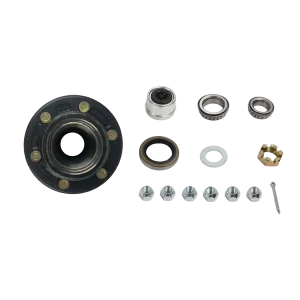
5200-7000lb (3175kg) idler hub for US market (key load-bearing part). Reliable heavy-load & rotation, fits medium-duty cargo/RV/agricultural trailers (FMVSS compliant). Customizable: load/size/environment.
Core Specifications
| Parameter Category | Specific Specification | Key Description |
| Rated Load Capacity | 5200-7000lb(3175kg) | Fits axles; |
| Brake Type | Idler (Non-Brake) | No brakes; uses tow vehicle’s |
| Compatible Axle Diameter | 1.75-2.125 inches | Fits US medium-heavy axles; custom for non-standard |
| Bearing Configuration | Double-Row Tapered Roller Bearings | High load/impact resistance, even load distribution |
| Hub Material | High-Strength Cast Iron | ASTM A536 ductile iron, durable/wear-resistant |
| Surface Treatment | Hot-Dip Galvanization / Powder Coating | Corrosion-resistant; custom for coastal/humid areas |
| Bolt Specification | 6/8 Holes, 5/8″-18 UNF Thread | US auto-grade; customizable holes/threads |
Key Features
- Double-Row Bearings: Heavy load & anti-vibration.
- Hub Shell: Precision-cast iron, durable.
- Connecting Bolts: High-tensile steel, secure.
- Oil Seal: Temp-resistant, anti-leakage.
- Dust Cover: Debris-proof, extends life.
- Manufacturing & Quality Assurance
- Manufacturing Processes
- Material: Ductile iron casting + heat treatment.
- Machining: CNC (±0.02mm) for US axle fit.
- Surface: Galvanization + powder coating (anti-rust).
- Assembly: “Clean-Fit-Tighten-Inspect” + torque check.
- Quality Inspection
- Load Test: 24h 1.2x load (no deformation = pass).
- Dynamic Balance: Runout < 0.2mm (low vibration).
- Sealing Test: 50PSI air test (anti-leakage).
- Material Test: Spectral analysis (meets ASTM A536).
III. Application Scenarios & Installation Maintenance
Application Scenarios:
- Cargo Trailers: Dry van/flatbed, long-haul stable.
- RV/Agricultural: Heavy load, rugged conditions.
Installation & Maintenance:
- Installation: Clean axle; 2/3 lithium grease; torque 120-150 ft-lbs; seal.
- Maintenance: Inspect 4m/8k miles; grease semi-annually (quarterly harsh env).
- Abnormality: Replace damaged seals; stop use on noise/overheating.
- Product Advantages
- Core Advantages
- Market Fit: FMVSS compliant, fits top US brands.
- Reliable: Double-row bearings + cast iron, 30% less maintenance.
- Weather Resistant: Dual-layer treatment for US climates.
- Durable: 20% longer life than industry avg.
- Customization: One-stop (drawings/params); custom passes tests.
About Us
20 years of trailer axle manufacturing experience. Specialized in Australian customization (45/50mm options). Compliant with standards, 24h after-sales, on-time delivery to Australia.
Attention Notes
All parts in one—ready to install, no missing pieces.
Sealed tight, keeps out dirt and water for longer life.
Smooth spin, cuts friction so wheels roll steady.
Fits most trailers, from small utility to big hauls.
Tough build handles heavy loads without wobbling.
Easy to swap, basic tools get the job done fast.