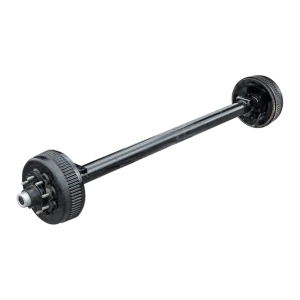
Trailer Axle

No more posts to show

Trailer Axles: Key Basics for Choosing the Right One

Trailer axles are critical for safety and performance—pick the wrong one, and you’ll deal with instability, breakdowns, or even accidents. We’re cutting through the jargon to focus on what matters: the 3 main axle types, 3 brake options, and how to choose.

The key is matching your axle (and brakes) to how you use the trailer—load size, terrain, and how often you maintain it.

Basic: What a Trailer Axle Does

An axle connects the wheels, supports your load, and works with brakes to stop safely. It soaks up bumps to keep the ride stable—simple as that.

2 Main Axle Types: Pros & Best Uses

These two axle types cover most needs, with straight axles standing out for versatility and safety.

  1. Straight Axles (The Tough One)

Most common axle—adopts high-hardness, high-toughness special alloy steel for the shaft, featuring excellent fatigue resistance. It uses stacked steel “leaves” (springs) to handle heavy loads and rough terrain.

Top Pros:

  • Hauls from 2,000 to 20,000+ lbs (gravel, equipment)
  • Super easy to fix—parts at any auto shop
  • You can see wear (no surprise breakdowns)

Best For: Virtually all trailer types—RVs, food trucks, construction trailers, toilet trailers, dump trailers, and flatbeds. Key Strengths: Exceptionally safe and stable, less prone to damage, with an ultra-high safety factor.

  1. Torsion Axles (The Smooth One)

The shaft is made of fatigue-resistant special steel. It uses internal rubber/steel to absorb shocks—no external springs.

Top Pros: Quiet, smooth ride, saves under-trailer space.

Best For: Boats, RVs, light/medium loads (2,000–7,000 lbs).

Note: Requires whole-axle replacement if internal parts fail; rubber rods wear over time—check regularly.

Top 2 Recommended Brake & Axle Combos + Other Options

  1. Straight Axle + Electric Magnetic Brakes (Top Recommendation)

Electric magnetic brakes work by activating magnets via an electrical signal from the tow vehicle—this pushes brake shoes against rotors/drums for smooth stopping. Paired with straight axles (special alloy steel shaft), it’s a perfect blend of control and durability.

Top Pros:

  • Adjustable braking force adapts to loads (2,000–15,000 lbs)
  • No manual effort—integrates seamlessly with tow vehicle controls
  • Straight axle’s easy repairs + magnetic brakes’ low upkeep
  • Reliable in wet/dusty conditions (no fluid leaks or cable rust)

Best For: RVs, food trucks, logistics trailers, and construction trailers—versatile for daily use.

  1. Straight Axle + Disc-Style Mechanical Brakes (Top Recommendation)

Disc-style mechanical brakes use cable/lever operation to clamp pads onto discs—excellent heat dissipation prevents braking fade. When paired with straight axles, it’s built for heavy-duty use and harsh environments.

Top Pros:

  • Fade-free stopping
  • Mechanical design = no electrical/fluid failures
  • Straight axle’s fatigue resistance + disc brakes’ long pad life
  • Easy to inspect and adjust (no specialized tools needed)

Best For: Dump trailers, agricultural trailers, heavy flatbeds—tough for job sites.

  1. Other Brake Options (For Specific Needs)

Austrian-Style Disc Brakes: High-performance for highway haulers (fast response, specialized repairs needed).

Hydraulic Brakes: Smooth for boats/RVs (requires regular fluid checks).

Mechanical-Electric Combined Brakes: Dual safety (electric main + mechanical backup) for long-haul semi-trailers (10,000–20,000 lbs).

  • Grease Bearings: Yearly or every 12k miles—dry bearings break axles.
  • Prevent Rust: Wash off salt/mud; touch up chipped paint.
  • Check Brake & Axle Parts: Straight axles: Inspect leaf springs; Magnetic brakes: Test electrical connections; Disc mechanical brakes: Check pad wear and cable tension.

For most users, our two top combos are unbeatable: Straight Axle + Electric Magnetic Brakes for versatile, daily hauling (RVs, food trucks, logistics) and Straight Axle + Disc-Style Mechanical Brakes for heavy-duty, harsh-environment work (dump trailers, job sites). Both leverage straight axles’ safety and special steel durability—paired with brakes that match your load and use case, you’ll haul safely every time.


Item #1

Contact Us